Introduction
Software engineering is changing rapidly. AI tools have moved from assistants to active contributors in coding, review, design, documentation, and operations. In controlled experiments, developers using an AI pair programmer completed tasks 55.8% faster than those without one [1], and across field experiments with nearly 4,900 developers, AI access increased completed tasks by roughly 26% [2].
These are not marginal improvements. When engineering moves this much faster, adjacent functions — product, design, operations, legal, marketing, and leadership — become the next bottlenecks. Requirements that were vague but tolerable when implementation took weeks become blockers when a working prototype can be produced in hours. Review processes that assumed a slower cadence of change struggle to keep up with the volume of output.
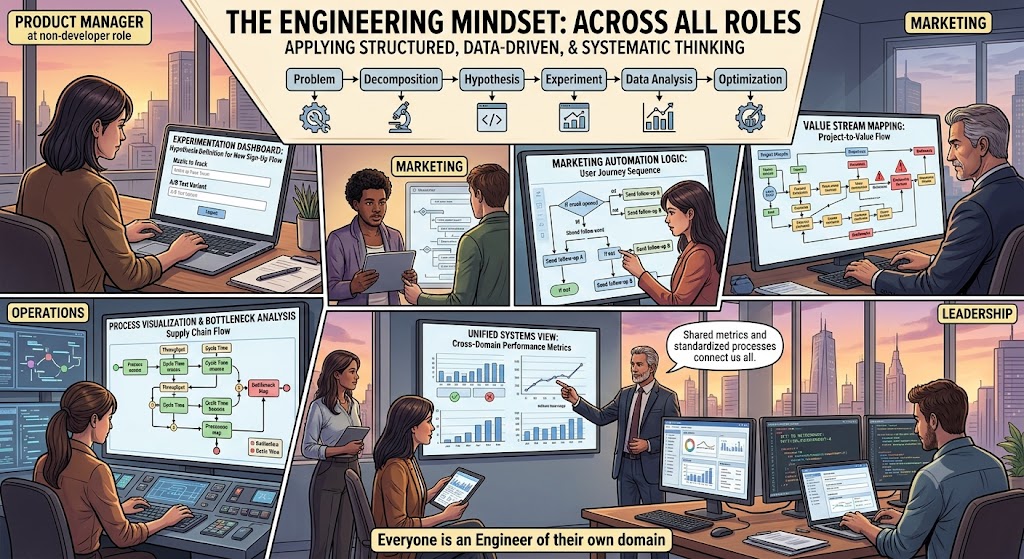
This post is a practical reflection on what that shift means for organizations. The central argument is simple: not everyone needs to become a software developer, but more people will need to adopt an engineering mindset.
"The future of work is not simply 'AI replaces people.' It is 'AI rewards people who can turn work into structured, repeatable, improvable systems.'"
The Strategic Shift: Execution Is Getting Cheaper
AI compresses the distance between idea, draft, prototype, implementation, and iteration. Tasks that used to take days can now produce a useful first version in minutes or hours. This is not a marginal efficiency gain. McKinsey estimates that generative AI could add the equivalent of $2.6 trillion to $4.4 trillion in value annually across the use cases it analyzed [3].
But this does not eliminate the need for people. It changes where human value sits. When output becomes cheaper, the scarce capabilities become:
-
Understanding the right problem
Identifying what actually needs to be solved, not just what can be built.
-
Supplying the right context
Giving AI tools the constraints, examples, and domain knowledge they need to produce useful results.
-
Evaluating whether output is correct
AI produces confident results that may be incomplete, wrong, or subtly misleading.
-
Designing repeatable workflows
Building systems that can run safely more than once, with consistent quality.
-
Knowing when human judgment is required
Recognizing the boundary between automation and decisions that need a person.
In many organizations, AI adoption starts as a tooling decision. Which model should we use? Which assistant should we buy? But the real transformation begins when teams realize that model choice is the easy part. The harder question is how work should be designed around AI — how to structure inputs, review outputs, govern data, and maintain accountability.
Why Product, Design, and Operations Are Next
Engineering teams are usually the first to feel the AI shift because software development has clear artifacts: code, tests, repositories, reviews, CI/CD pipelines, and production systems. The value is also concentrated where these functions live — McKinsey found roughly 75% of generative AI's potential value falls in just four areas: customer operations, marketing and sales, software engineering, and R&D [3].
But other functions increasingly face the same pressure. As AI accelerates what engineering can deliver, the quality of inputs from other teams becomes a direct constraint on output quality.
-
Product teams
Need clearer, more testable requirements — goals, non-goals, edge cases, and acceptance criteria that both humans and AI agents can act on.
-
Design teams
Need reusable systems and assets that can be incorporated into automated workflows, not just one-off screens.
-
Operations teams
Need documented playbooks, triggers, escalation paths, and monitoring — not tribal knowledge locked in people's heads.
-
Leadership
Needs governance around data, model usage, cost, security, and accountability — not just a procurement decision.
The question is not whether these functions will become technical. The question is whether they will become system-oriented — whether they can structure their work in ways that are explicit, repeatable, and improvable.
What an Engineering Mindset Really Means
The phrase "engineering mindset" does not mean everyone writes code. It means adopting the practices that engineers have traditionally used to manage complexity in systems that evolve over time.
Versioned Work
Important assets — prompts, templates, specifications, workflows — should be tracked, reviewed, and improved over time rather than re-created from scratch each time they are needed.
Clear Specifications
AI performs better when intent, constraints, examples, and acceptance criteria are explicit. Vague instructions produce vague results.
Reusable Components
Teams should avoid reinventing the same prompt, document, workflow, or asset repeatedly. Shared building blocks multiply quality and consistency.
Feedback Loops
Outputs should be reviewed, tested, measured, and improved. Without feedback, workflows drift and quality erodes.
Operational Ownership
Someone must own the system after it is created. A workflow without an owner is a workflow that will break silently.
Governance by Design
Security, privacy, and data ownership should be built into workflows from the start rather than added as afterthoughts.
This direction aligns with where the labor market is heading. The World Economic Forum's Future of Jobs Report 2025 finds that employers expect 39% of core skills to change by 2030, with analytical thinking, AI and big data, technological literacy, resilience, and lifelong learning ranking among the most important capabilities [4].
"The engineering mindset is not about turning every employee into a programmer. It is about making work explicit enough that people and machines can collaborate on it reliably."
Practical Examples
Design: From One-Off Assets to Design Systems
Designers can move beyond producing individual screens or static files. They can own design systems, reusable components, brand rules, generation prompts, and quality standards. AI-generated design output improves when the underlying assets and instructions are treated as living systems rather than one-time deliverables.
The designer's value shifts from producing every variation manually to defining the system that produces consistent variations.
Product: From Vague Requirements to Executable Context
Product teams can write requirements that serve both humans and AI agents. Better product specs include goals, non-goals, user stories, constraints, edge cases, acceptance criteria, and examples. This helps engineering teams and AI tools converge faster on useful outcomes — and reduces the costly cycles of misunderstanding that slow delivery.
Product work becomes more valuable when it creates high-quality context for decision-making and execution.
Operations: From Manual Repetition to Playbooks
Repeated operational tasks can become documented, automated, and monitored workflows. Examples include customer onboarding, support escalation, incident response, reporting, compliance checks, and internal approvals. AI can assist with execution, but the organization still needs clear ownership and escalation paths.
The goal is not automation for its own sake. The goal is repeatability, visibility, and resilience.
Leadership and Governance: From AI Tools to AI Architecture
Leaders should avoid treating AI adoption as a simple procurement decision. The real challenges sit underneath the tooling:
-
Data residency
Where does company data live, and does the AI provider retain it?
-
Context and retrieval
Which systems retrieve context, and how is relevance determined?
-
Model selection
Which model is used for which task, and how are costs and quality monitored?
-
Accountability
Who is responsible when AI output causes harm or makes a wrong decision?
Established frameworks already exist for this kind of work. The NIST AI Risk Management Framework organizes the effort into four ongoing functions — Govern, Map, Measure, and Manage — and treats data governance, documentation, and clear ownership as continuous requirements rather than afterthoughts [5]. This connects to a broader principle: the AI provider should not automatically become the data storage provider, retrieval layer, workflow owner, and model provider all at once.
Model choice is easy. Data governance, architecture, and accountability are the real leadership challenges.
Risks and Misconceptions
As the engineering mindset spreads across organizations, several misconceptions and risks deserve attention.
Misconceptions
-
"Everyone must learn to code."
Better framing: everyone needs to understand systems, constraints, and feedback loops. Code is one implementation detail, not the point.
-
"AI fluency is enough."
Better framing: AI fluency without governance creates fragile workflows. Knowing how to use a tool is not the same as knowing when to use it, or how to keep it safe.
-
"More automation always means better productivity."
Better framing: automation only helps when the workflow is well understood. A study of consultants at BCG identified three ways people work with AI — "centaurs" who direct it and deepen their expertise, "cyborgs" who blend their work with it and build new AI skills, and "self-automators" who hand tasks off and gain neither [6]. The same tool produces very different outcomes depending on how deliberately it is used.
Risks
-
Data exposure
Teams may feed sensitive internal data into AI tools without understanding retention, training, or access implications. Without clear data governance, every prompt becomes a potential leak.
-
Loss of apprenticeship
Junior workers may lose the traditional hands-on tasks that helped them build expertise — drafting, researching, organizing — unless organizations deliberately redesign learning paths [6].
Key Takeaways
-
AI is making execution faster, but not automatically better
Speed without structure produces more noise, not more value.
-
The bottleneck is shifting from output to system design
Producing output is getting cheaper. Designing reliable systems of work is the new constraint.
-
The engineering mindset is spreading beyond engineering
More functions now need structured, repeatable, governed workflows — not just the teams that write code.
-
Product, design, operations, and leadership all need stronger habits
Specification, ownership, review, and iteration are becoming universal disciplines.
-
The most valuable workers will combine domain expertise, AI fluency, judgment, and systems thinking
No single skill is enough. The combination is what creates durable value.
Conclusion
AI does not remove the need for engineering discipline. It expands where that discipline matters.
Organizations should not panic about everyone becoming a software engineer. Instead, they should help more teams adopt the habits that make engineering effective: clarity, modularity, feedback, ownership, and responsible automation. These are not technical skills in the narrow sense. They are ways of working that scale — and they scale especially well when intelligent systems are involved.
The teams that will thrive are those that can take messy human work and turn it into systems that humans and machines can improve together. That does not require everyone to write code. It requires everyone to care about how work is structured, reviewed, and governed.
"The future belongs to teams that can turn messy human work into systems that humans and machines can improve together."
Sources and Further Reading
Microsoft Research [1]
The Impact of AI on Developer Productivity: Evidence from GitHub Copilot — Peng, Kalliamvakou, Cihon & Demirer, 2023
Read PaperMIT / Microsoft [2]
The Effects of Generative AI on High-Skilled Work: Evidence from Three Field Experiments with Software Developers — Cui, Demirer, Jaffe et al., 2024
Read PaperMcKinsey & Company [3]
The Economic Potential of Generative AI: The Next Productivity Frontier, 2023
Read ReportHarvard Business School [6]
Cyborgs, Centaurs and Self-Automators: The Three Modes of Human–GenAI Knowledge Work — Kellogg et al., 2024
Read Paper