Introduction
Artificial intelligence is no longer a distant technology trend. It is already entering daily workflows, reshaping how companies operate, how customers are served, and how knowledge work gets done. Much like the rise of agentic AI systems, we are moving from passive tools toward intelligent systems that can retrieve information, generate output, refine decisions, and support complex workflows with less direct human intervention.
This shift will have a major impact on the labor market. But the story is not simply that AI will "replace jobs." A more realistic view is that AI will reshape work at the task level. Some tasks will be automated, some will be accelerated, and others will become more valuable because they require human judgment, trust, creativity, or domain expertise.
The central question is no longer whether AI will affect work. It already is. The more important question is: which skills will matter most as AI changes what work is worth?
"The near-term shift is less about entire occupations disappearing overnight and more about roles being redesigned around AI-assisted workflows."
AI Is Changing Tasks Before It Replaces Jobs
Most jobs are bundles of tasks. A marketing role may include research, writing, analytics, stakeholder management, and creative direction. A customer service role may include answering routine questions, handling escalations, resolving emotional situations, and improving support processes.
AI does not affect all of those tasks equally.
Generative AI is strongest where work is structured, repetitive, language-heavy, or pattern-based. It can summarize documents, generate drafts, classify information, answer routine questions, produce code snippets, and support analysis. That makes it powerful, but also uneven in its impact.
The International Labour Organization's research on generative AI and jobs argues that AI is more likely to augment many roles than fully automate them, while clerical and administrative work remains especially exposed.
The near-term labor market shift is therefore less about entire occupations disappearing overnight and more about roles being redesigned around AI-assisted workflows.
Why This Automation Wave Is Different
Automation is not new. Manufacturing, logistics, finance, customer service, and back-office operations have all been transformed by software and automation over the past several decades.
What makes this wave different is that generative AI reaches deeply into knowledge work.
AI can now assist with:
-
Writing and editing
Drafts, revisions, and structured communication at scale.
-
Research and summarization
Faster synthesis of documents, reports, and knowledge bases.
-
Customer communication
Routine inquiries, routing, and first-line support.
-
Software development
Code generation, review support, and workflow automation.
-
Document review
Classification, extraction, and consistency checks.
-
Data analysis and decision support
Pattern detection, reporting, and scenario exploration.
This means white-collar work is no longer insulated from automation. The same pattern we see in AI-powered travel platforms—where systems can manage bookings, monitor disruptions, and provide real-time support—is now emerging across many industries.
The result is not a simple replacement of humans by machines. It is a redistribution of work between humans and intelligent systems.
Which Jobs and Functions Are Most Exposed?
The roles most exposed to AI tend to share a few characteristics:
-
Repetitive workflows
Tasks that follow predictable patterns and rules.
-
Structured information
Work that depends on documents, forms, tickets, or logs.
-
Standardized outputs
Reports, emails, summaries, and routine deliverables.
-
Text-heavy work
Classification, summarization, and language generation.
-
Less interpersonal trust
Tasks with lower stakes for empathy, accountability, or context.
Administrative and Clerical Work
Administrative roles often include scheduling, data entry, document processing, routine correspondence, and reporting. These tasks are highly exposed because they are structured and repeatable.
The value of purely routine execution may decline, while coordination, confidentiality, judgment, and process ownership may become more important.
Customer Support
AI-powered assistants can already answer routine questions, route tickets, manage bookings, process requests, and provide real-time updates. However, human agents remain essential for complex, emotional, or high-stakes situations where empathy and accountability matter—as explored in our analysis of AI in travel and customer operations.
Routine Knowledge Work
Many knowledge workers spend time producing first drafts, summaries, reports, research briefs, and spreadsheet analysis. AI can accelerate much of this work.
That does not eliminate the need for people. But it does shift the value toward reviewing, interpreting, improving, and applying the output.
Entry-Level White-Collar Roles
Entry-level workers may face one of the most complex transitions. Many junior roles traditionally involve simpler tasks that help people learn: drafting, researching, organizing data, and preparing reports.
If AI automates those apprenticeship tasks, companies will need new ways to help early-career workers build judgment, context, and expertise.
AI as a Productivity Shock
AI should not only be understood as a labor replacement tool. It is also a productivity shock.
McKinsey Global Institute has estimated that generative AI could add trillions of dollars in annual economic value, especially in customer operations, marketing and sales, software engineering, and research and development.
The reason is simple: AI compresses the time between idea, execution, and iteration.
A team that once spent days creating a first draft, analyzing documents, or preparing customer responses may now do the same work in hours. This creates real efficiency gains, but it also forces organizations to rethink workflows, governance, and accountability.
Just as scalable technology platforms need modularity, automation, observability, and resilience, AI-ready organizations need workflows that can evolve as tools, roles, and expectations change—as discussed in building platforms at scale.
When production gets cheaper and faster, the bottleneck shifts from output volume to quality control, governance, and judgment about what should be done at all.
What This Means for the Labor Market
The labor market impact of AI will likely unfold across several dimensions.
Routine Work Becomes Less Valuable
If a task can be completed faster, cheaper, and at acceptable quality by AI, the market value of doing that task manually will decline.
Human Judgment Becomes More Important
As AI generates more output, the bottleneck shifts from production to evaluation. People will be needed to judge whether the output is accurate, useful, ethical, and aligned with the goal.
Hybrid Workers Gain an Advantage
The most valuable workers will combine domain expertise with AI fluency. They will understand the business problem, know how to use AI tools, and be able to evaluate whether the result actually makes sense.
Skill Gaps May Widen
The IMF has estimated that a significant share of global employment is exposed to AI, with exposure even higher in advanced economies. This creates a risk that workers with access to skills, tools, and training benefit disproportionately, while others fall behind.
Organizations Will Redesign Roles
Companies may need fewer people doing repetitive execution and more people managing exceptions, supervising AI outputs, improving systems, maintaining data quality, and coordinating human-AI workflows.
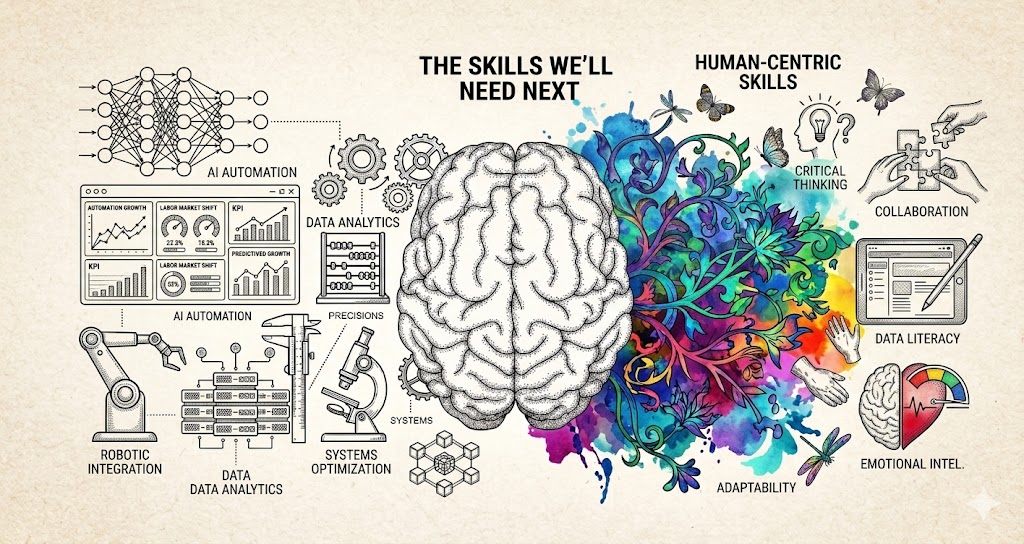
The Skills We'll Need Next
The World Economic Forum's Future of Jobs research highlights analytical thinking, resilience, flexibility, leadership, creative thinking, AI, big data, and technological literacy as increasingly important skills.
Several capabilities stand out.
-
AI Literacy
Workers do not all need to become AI engineers. But many will need to understand how to use AI tools, where they fail, how to protect sensitive data, and how to evaluate AI-generated output.
-
Critical Thinking and Judgment
AI can generate confident answers that are incomplete or wrong. Human judgment becomes the quality-control layer—asking whether output is accurate, what context is missing, and what could go wrong.
-
Problem Framing
AI is most useful when the problem is clearly defined. The ability to ask the right question, define constraints, and identify success criteria will become a major advantage.
-
Data Fluency
As AI becomes embedded in business workflows, workers will need to understand data quality, metrics, patterns, and uncertainty. AI output is only as useful as the information behind it.
-
Adaptability
Tools will change quickly. The durable skill is not mastery of one platform, but the ability to keep learning and adapting.
-
Communication and Collaboration
AI can generate output, but humans still need to align teams, explain trade-offs, persuade stakeholders, and create shared understanding.
-
Human-Centered Skills
Empathy, leadership, negotiation, ethical judgment, creativity, and relationship-building remain essential where trust and accountability matter.
-
Domain Expertise
AI can produce options, but experts still know what matters in context. Domain expertise is the filter that separates useful insight from generic output.
What Workers Should Do Now
The best response to AI disruption is preparation, not panic.
-
Map your role into tasks
Identify which parts of your work are repetitive, judgment-heavy, relationship-based, or domain-specific.
-
Learn one AI tool deeply
Use it for drafting, research, summarization, analysis, or workflow support.
-
Build a human + AI workflow
Let AI accelerate the first pass, but keep human review in control.
-
Strengthen one technical and one human skill
For example, AI literacy plus communication, or data analysis plus critical thinking.
-
Practice verification
Treat AI output as a draft, not a final answer.
The future worker is not just a prompt writer. The future worker is an editor, reviewer, strategist, and accountable decision-maker.
What Employers Should Do
Organizations also need to manage this transition intentionally.
-
Invest in reskilling early
Training should begin before roles become obsolete.
-
Redesign work around augmentation
The goal should not only be automation, but better human-AI collaboration.
-
Protect entry-level learning
If AI automates junior tasks, companies need new apprenticeship models.
-
Build AI governance
Define rules for privacy, quality control, human review, bias monitoring, and accountability.
-
Measure more than speed
Productivity matters, but quality, trust, resilience, and decision-making matter too.
Responsible AI adoption requires the same discipline as any major technology transformation: clear architecture, oversight, feedback loops, and continuous improvement—as explored in agentic AI systems and architecture at scale.
Risks and Open Questions
AI creates major opportunities, but also serious risks.
-
Job displacement
Some roles will shrink or disappear.
-
Inequality
Benefits may flow disproportionately to workers and firms already positioned to adopt AI.
-
Loss of apprenticeship paths
If junior tasks disappear, new workers may struggle to build expertise.
-
Overreliance on AI
Workers may lose foundational skills if they stop practicing them.
-
Trust and accountability
Organizations need clarity on who is responsible when AI-assisted decisions go wrong.
These challenges do not mean AI should be avoided. They mean adoption must be thoughtful, transparent, and human-centered.
Conclusion
AI is reshaping the labor market by changing what work is worth.
The disruption will not be evenly distributed. Some tasks will be automated. Some roles will be redesigned. Some workers will become more productive, while others may find that their current skills are less valuable.
The skills we need next are becoming clear: AI literacy, critical thinking, adaptability, problem framing, data fluency, communication, domain expertise, and human-centered leadership.
The future of work will not be defined by humans competing against machines task by task. It will be defined by how well we redesign work around the strengths of both.
AI will handle more of the routine, repetitive, and scalable parts of work. Humans will still be needed for judgment, trust, creativity, context, and accountability.
"The challenge is not simply to survive automation. It is to build the skills that make us more valuable in an automated world."
Actionable Takeaways
-
Audit your current role
Identify which tasks are most exposed to AI.
-
Build AI literacy
Learn how to use AI tools responsibly and effectively.
-
Invest in judgment
Verification, critical thinking, and context will matter more.
-
Strengthen human skills
Communication, empathy, leadership, and trust remain essential.
-
Keep learning
Adaptability may be the most important skill of all.
Sources and Further Reading
International Labour Organization
Generative AI and Jobs: A global analysis of potential effects on job quantity and quality (2023)
Read ReportInternational Monetary Fund
Gen-AI: Artificial Intelligence and the Future of Work (2024)
Read Article