Everyone Did Their Job
Imagine an AI-enabled customer-service workflow that can approve refunds. It has handled routine requests successfully for months. Then a change in upstream data causes it to misread a class of claims. By the time someone intervenes, thousands of customers have received refunds they were not entitled to.
The post-incident review begins, and everyone can show that they did their job.
The CEO approved the AI strategy and set the organization's risk appetite. The CIO connected the workflow to customer, payment, and service platforms. The CTO's team built a reliable system and passed every release gate. The CISO established identity controls, monitoring, and incident procedures. Legal reviewed the policy. The model performed within its test thresholds before launch.
There was governance everywhere. Yet the first question from the board has no obvious answer:
"Who owned the decision this system was allowed to make?"
This is a hypothetical scenario, but the accountability gap is real. Organizations are distributing AI responsibility across executives, committees, product teams, data offices, security functions, and vendors. That is necessary: AI reaches too far across the enterprise to belong to one department.
But shared responsibility creates a dangerous illusion: because many people contribute to a system, the organization assumes someone must own its consequences.
Often, nobody does.
When everyone owns AI in general, nobody may own what a particular AI system does.
The Org Chart Is Not the Operating Model
Executive responsibility maps are useful. They help separate broad concerns that should not collapse into one role.
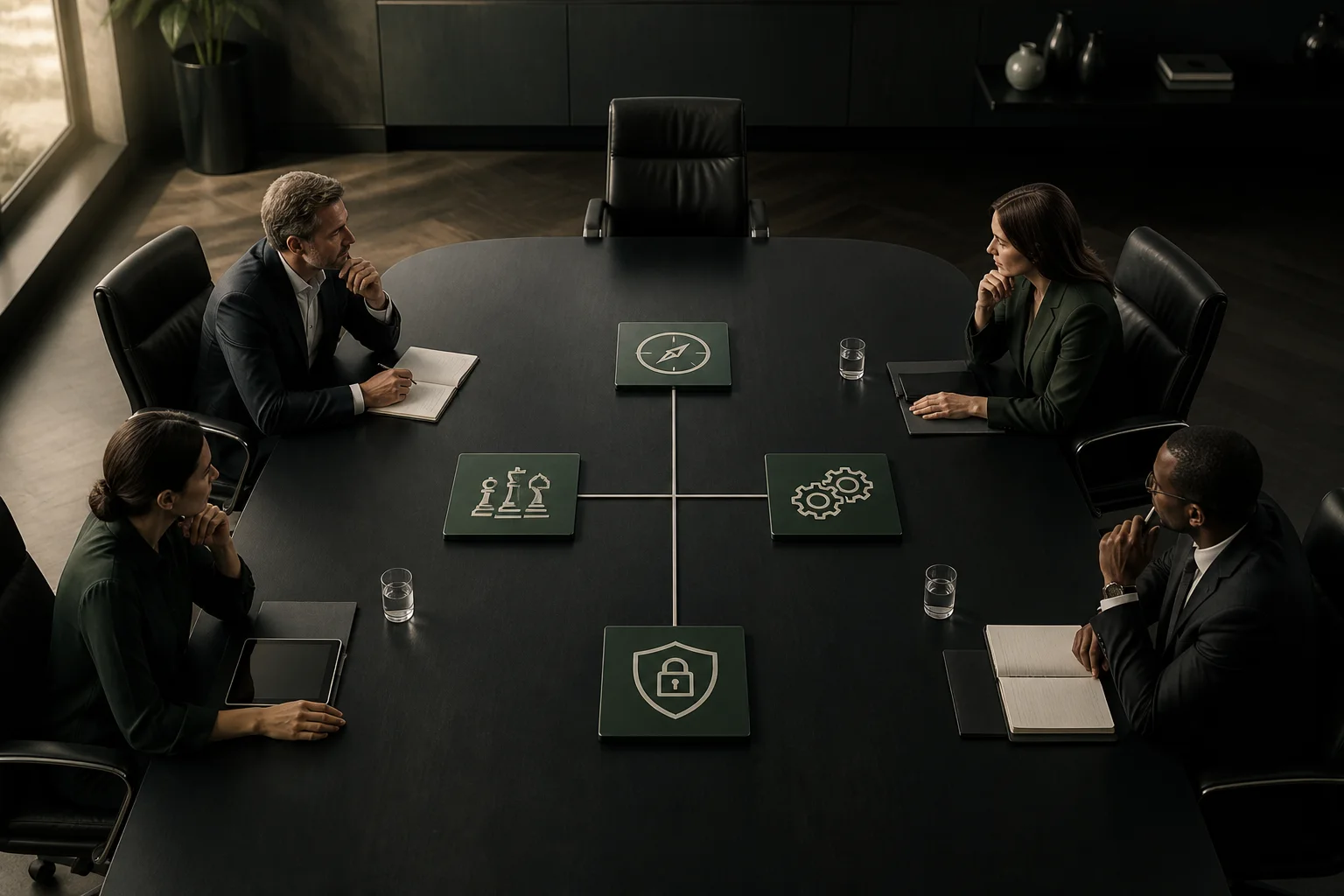
The board and CEO define ambition, risk appetite, and accountability expectations. The CIO connects data, processes, platforms, vendors, and operations. The CTO turns strategy into architecture and working systems. The CISO protects the organization through security, resilience, and control. Data, risk, legal, privacy, compliance, operations, and internal audit all bring responsibilities that cannot simply be delegated to "the AI team."
That describes who governs the enterprise capability. It does not tell us who owns an individual business outcome.
Platforms, models, data products, security controls, and vendor relationships can all have owners. None necessarily owns the decision made when those components meet inside a customer or operational workflow.
Organizations do not experience AI risk as a diagram. They experience it when a system changes a price, recommends a loan, rejects a candidate, releases a payment, modifies inventory, or communicates with a customer.
The closer AI gets to consequential action, the less useful category-level ownership becomes.
"Governing AI as an enterprise capability is different from accepting accountability for an AI-enabled business outcome."
Two Layers of AI Governance
Enterprise Governance Sets the Boundaries
The first layer establishes the conditions under which AI may be developed, acquired, deployed, and used.
This is where the board and executive team define strategic objectives, prohibited uses, risk appetite, architecture standards, data requirements, security controls, procurement rules, documentation expectations, escalation thresholds, and assurance mechanisms. It creates consistency across the portfolio and prevents every team from inventing its own version of responsible AI.
The NIST AI Risk Management Framework treats governance as a continuous function across the AI lifecycle. Its GOVERN 2 category calls for documented responsibilities and communication lines, empowered and trained individuals, and executive responsibility for decisions about risks associated with AI development and deployment [1].
ISO/IEC 42001 takes a similar organization-wide view. It defines an AI management system that connects leadership, policy, responsibilities, risk management, monitoring, and continual improvement [2].
Governance is not a final approval meeting. It is the management system surrounding AI from intent through operation.
But enterprise governance should not force every use-case decision through one central committee. That creates delay without necessarily creating ownership. Its purpose is to set clear boundaries inside which accountable people can act.
Use-Case Ownership Accepts the Consequences
The second layer attaches accountability to the workflow AI changes.
Every material AI use case needs one named business owner from the function whose outcome, customer, employee, or obligation is affected. A customer-service leader owns an automated refund workflow. A credit leader owns an AI-supported lending recommendation. An HR leader owns an AI-supported hiring process. An operations leader owns an agent that changes inventory or production schedules.
The owner does not need to build the model or operate the platform. They do need to understand the purpose, limitations, and potential consequences well enough to define what good looks like, decide which failures are unacceptable, accept or escalate residual risk, and intervene when reality departs from the approved case.
Technology remains responsible for reliable implementation. Security remains responsible for protection and challenge. Legal, privacy, compliance, and risk retain their responsibilities. Independent assurance remains independent.
"Technology can operate the system. Security can protect it. Risk can challenge it. But the business must own what it is allowed to do."
The OWNER Test
Naming an owner is not enough. A person's name on a register can create the appearance of control while giving them neither information nor authority.
The OWNER test turns the label into an operating arrangement.
O — Outcome
What business outcome does the system influence, and which measures define success? The owner must see both value and harm: errors, complaints, unequal outcomes, financial leakage, or safety events.
W — Written Authority
Who may approve deployment, accept residual risk, and grant an exception? Decision rights should be explicit, with limits and review dates—not inferred during an incident.
N — Named Human
Which person—not department, committee, or mailbox—has accepted accountability? The record needs a name, scope, acknowledgment, and formal succession process.
E — Escalation
Which conditions require human review, where do they go, and who resolves the trade-off when speed, feasibility, and risk point in different directions?
R — Runtime Control
Which signals reach the owner after launch? They need relevant performance, exception, complaint, incident, and harm signals—and authority to pause, restrict, roll back, or retire the capability.
If an organization cannot answer all five questions, it has assigned stakeholders—not ownership.
Accountability Is Not the Same as Doing Everything
Singular accountability does not mean creating an all-powerful owner.
The business owner should not necessarily operate the platform, administer access, implement security controls, validate their own compliance, and assure their own decisions. Combining all of those duties would replace an accountability gap with a conflict of interest.
- Accountability
Owning the outcome and its consequences.
- Execution
Building and operating the capability.
- Oversight and challenge
Setting controls, testing assumptions, and questioning decisions.
- Assurance
Independently assessing whether governance and controls work as intended.
The Institute of Internal Auditors' Three Lines Model separates management's responsibility for achieving objectives and managing risk from independent assurance [3]. AI does not invalidate that principle. It makes the interfaces between the lines more important.
The goal is not one person doing everything. It is one reconstructable chain of authority in which every participant's role is clear and the ultimate business outcome has an accountable owner.
Why Committees and RACIs Are Not Enough
Governance councils help establish standards, prioritize investments, coordinate expertise, and resolve escalations. RACIs help distinguish who is responsible, accountable, consulted, and informed.
Both are useful. Neither guarantees operational accountability.
A committee cannot personally receive an alert or make an urgent judgment. A RACI may mark several executives accountable, turning the most important box into a list. A technical product owner may be named even though the business function absorbs the consequence. An owner may approve launch but receive no runtime information. An exception may have no expiry. Responsibility may remain assigned to someone who left six months ago.
These are not documentation problems. They are breaks in the chain between authority and action.
Governance forums should manage the portfolio and its boundaries. Named owners should govern consequential use cases inside those boundaries. When a threshold is crossed, the escalation path should reconnect the two.
"Shared accountability is often just an accountability gap written in collaborative language."
Governance Must Reach Runtime
Many governance models are strongest before deployment and weakest after it.
The use case is inventoried. Risks are assessed. Tests pass. Approvals are recorded. The system goes live—and governance becomes monitoring owned by a technical team, disconnected from the person accountable for the business outcome.
That is exactly when governance needs to become active.
Runtime ownership requires agreed thresholds and alerts, meaningful value and harm metrics, a visible exception register, complaint and incident signals, control review dates, and tested pause or rollback mechanisms. The information must reach people who understand its significance and are authorized to respond.
European Commission guidance on the EU AI Act illustrates the direction for high-risk systems: deployers must assign human oversight to people who are sufficiently equipped and enabled, monitor operation according to the instructions for use, and act on identified risks or serious incidents [4].
The regulation is not the argument for ownership, and these obligations apply in a defined legal context. But the operating principle travels well: human oversight must be actionable. A name without information, competence, or authority is not oversight.
If no signal from the running system reaches an empowered human, accountability exists only on paper.
What Boards and CEOs Should Ask
Boards do not need to review model configurations. They do need evidence that authority follows consequence.
- Whose name appears next to the business outcome?
Not a committee, department, or technology vendor—a person who has accepted the scope.
- Which measures show value, and which reveal harm?
The owner must see both rather than celebrating productivity while another team absorbs the errors.
- Who can accept risk or stop the capability?
Authority to approve must be matched by authority to intervene.
- Which runtime signals reach that person?
Accountability without timely evidence is symbolic.
- What happens when the owner leaves?
Responsibility must be formally reassigned rather than inherited by an obsolete org chart.
- Could we reconstruct the authority chain six months later?
Consequential actions need durable evidence of who authorized what and within which limits.
The board-level question is not merely whether the AI system has an owner. It is whether every consequential decision has an accountable human.
A Practical Starting Point
Do not begin by redesigning the C-suite or creating another committee.
Start with the five most consequential AI use cases already in production or closest to deployment. Apply the OWNER test to each. Record the answers in the existing AI inventory or use-case register. Resolve missing authority, monitoring, escalation, and succession before expanding deployment.
This exercise will expose where the enterprise model is unclear without turning governance into a theoretical transformation program. It will also show whether controls are helping accountable leaders make decisions or merely adding approvals.
The mechanism should be light enough to use and strong enough to survive pressure, organizational change, and failure.
Clear decision rights do not slow responsible AI. They remove the uncertainty that causes late security reviews, repeated escalation, stalled deployments, and unowned exceptions.
"Speed and trust are not opposing goals. Ambiguity is the enemy of both."
Conclusion
In the opening scenario, strategy existed. Architecture existed. Security, legal review, monitoring, and testing existed. The governance failure was not inside any one function.
It was the missing connection between all of them: nobody owned the business decision the system was allowed to make.
AI can recommend, decide, and increasingly act. It cannot accept corporate accountability. Humans still own the authority, the risk, and the consequences.
Strong AI governance therefore works at two levels. Enterprise leaders set the boundaries together. One named business owner accepts accountability at the point where AI changes a consequential outcome.
Contribution can be shared. Expertise should be distributed. Challenge and assurance must retain their independence.
"When the board asks who allowed the AI to act, the answer should be a name—not a diagram."
Sources and Further Reading
NIST AI RMF 1.0 [1]
Artificial Intelligence Risk Management Framework—especially GOVERN 2 on accountability structures and executive responsibility.
Read FrameworkISO/IEC 42001:2023 [2]
The international standard for establishing, implementing, maintaining, and improving an AI management system.
View StandardThe IIA's Three Lines Model [3]
A governance model distinguishing management responsibility, risk and control roles, and independent assurance.
Explore ModelEuropean Commission AI Act Guidance [4]
Official guidance on deployer obligations, monitoring, and enabled human oversight for high-risk AI systems.
Read Guidance